


Software-defined networking (SDN) is revolutionizing how enterprise and telecom networks are built and managed. By separating the network’s control functions from its physical hardware, SDN offers unprecedented flexibility, automation, and efficiency.
What Is Software-Defined Networking?
Software-defined networking is an architecture that abstracts the network’s control and forwarding functions. In traditional networks, the control plane (which decides where traffic goes) and the data plane (which forwards the traffic) are tightly integrated within each network device, like a switch or router. SDN decouples these two planes.
This separation allows for centralized control of the entire network from a single software-based controller.
Administrators can manage traffic flows and deploy network services without needing to manually configure individual hardware devices. This programmability is the cornerstone of SDN.
The primary benefits of adopting SDN include:
- Centralized Management: Simplifies network administration by providing a single point of control.
- Increased Agility: Allows for rapid deployment and modification of network services and policies.
- Cost Efficiency: Reduces reliance on expensive, proprietary hardware and lowers operational expenses through automation.
- Enhanced Visibility: Offers a holistic view of the network, making it easier to monitor traffic and troubleshoot issues.
How SDN Works
To understand SDN, it’s essential to grasp its fundamental architecture, which is built on the separation of the control and data planes.
Control Plane vs. Data Plane
The control plane is the “brain” of the network. It determines the rules and policies for how data packets should travel across the network. It builds routing tables and makes high-level decisions about traffic flow.
The data plane (or forwarding plane) is the “muscle.” It consists of the network hardware (switches and routers) that physically forwards packets to their destination based on the instructions received from the control plane.
In an SDN environment, a centralized SDN controller manages the control plane for all devices on the network. This controller communicates with the network hardware through standardized protocols.
Key Protocols and Architecture
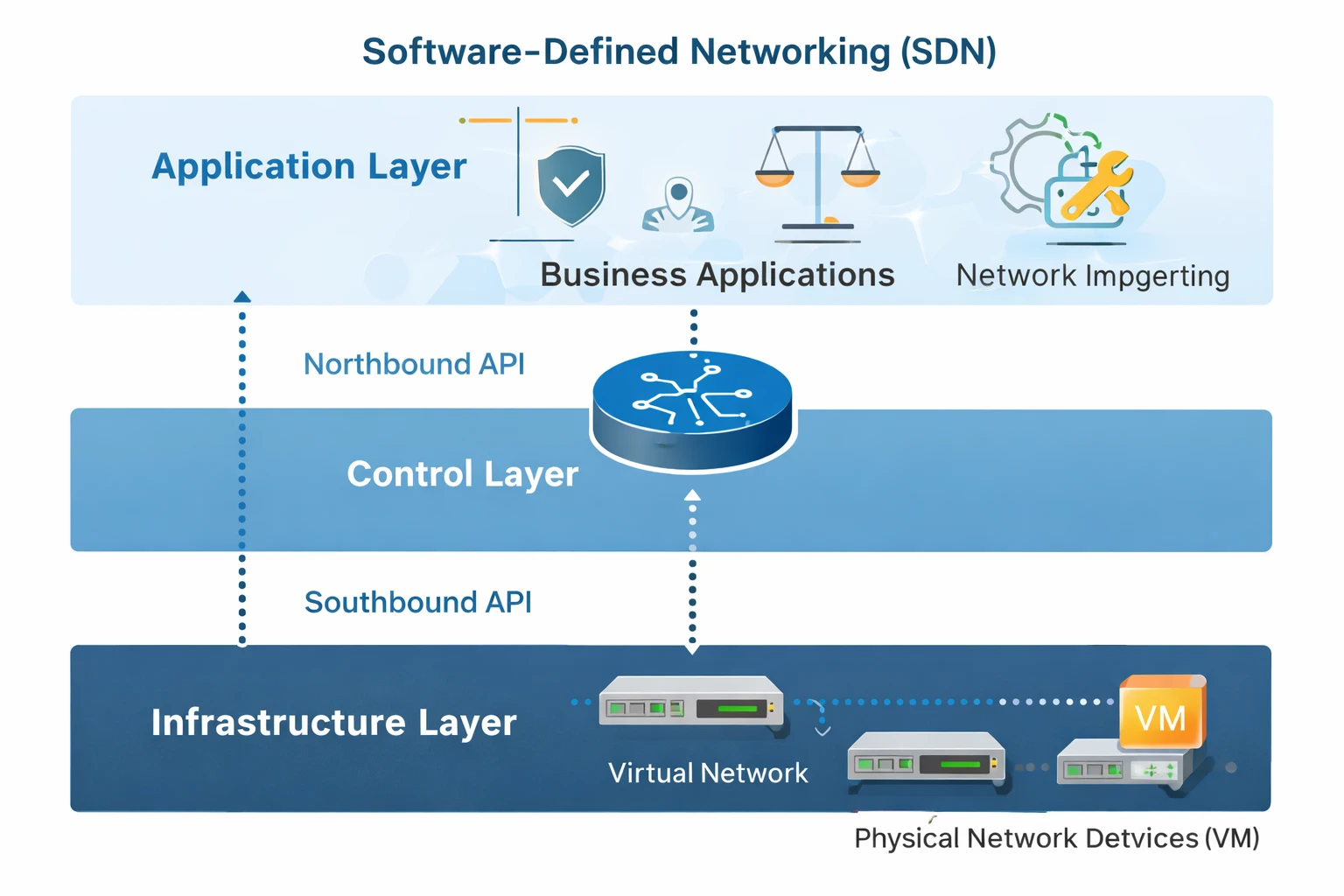
The SDN architecture is typically composed of three layers:
- Application Layer: This layer includes the business applications and services that use the network, such as firewalls, load balancers, and other network functions. These applications communicate their requirements to the SDN controller.
- Control Layer: This is where the SDN controller resides. The controller has a global view of the network and translates the requirements from the application layer into instructions for the data plane.
- Infrastructure Layer (Data Plane): This layer consists of the physical and virtual network devices that forward traffic.
The communication between the control and data planes is facilitated by a southbound API, with OpenFlow being the most well-known protocol. OpenFlow allows the SDN controller to directly program the forwarding tables of network switches.
Meanwhile, northbound APIs enable applications to interact with the controller, allowing for greater automation and service integration.
SDN Use Cases for Enterprises
For enterprises, SDN offers powerful solutions to common networking challenges, enabling greater automation, security, and cost savings.
Network Automation
Manual network configuration is time-consuming and prone to human error. SDN allows administrators to automate repetitive tasks, such as provisioning virtual networks, applying security policies, and managing quality of service (QoS).
This automation speeds up service delivery and frees up IT teams to focus on more strategic initiatives.
Enhanced Security
SDN’s centralized control enables more dynamic and granular security policies. This concept, known as micro-segmentation, involves dividing the network into small, isolated segments to prevent the lateral movement of threats.
If a security breach occurs in one segment, it can be contained, minimizing its impact on the rest of the network. The SDN controller can also automatically reroute traffic to avoid compromised devices or quarantine suspicious activity.
Cost Savings
By abstracting network control from hardware, SDN reduces vendor lock-in and allows enterprises to use more affordable, commodity hardware. Operational costs are also lowered through automation, which reduces the need for manual intervention and streamlines network management.
Furthermore, improved resource utilization ensures that network capacity is used efficiently, delaying the need for costly upgrades.
SDN Use Cases for Telecom

Telecom providers face immense pressure to deliver high-speed, reliable services to a growing number of users. SDN is a key enabler for modernizing their networks.
Network Function Virtualization (NFV)
Network Function Virtualization (NFV) is a complementary technology that decouples network functions—like firewalls, load balancers, and routing—from dedicated hardware. These functions can then run as virtual machines (VMs) on standard servers.
When combined with SDN, NFV allows telecom operators to dynamically create, manage, and scale network services on demand. This agility is crucial for launching new services quickly and efficiently.
5G and Edge Computing
The rollout of 5G networks demands a more flexible and intelligent network architecture. SDN provides the necessary programmability and automation to manage the complex traffic patterns of 5G.
It facilitates network slicing, which allows operators to create multiple virtual networks on a single physical infrastructure, each tailored to specific application requirements (e.g., low-latency for autonomous vehicles or high-bandwidth for video streaming).
SDN also plays a vital role in edge computing, where data is processed closer to the end-user to reduce latency. SDN controllers can dynamically manage traffic flows between the edge and the central cloud, optimizing performance for latency-sensitive applications.
The management of complex small cell networks is also simplified through SDN’s centralized control.
Challenges and Considerations

While SDN offers significant benefits, its implementation comes with certain challenges.
- Security: A centralized SDN controller can become a single point of failure and a prime target for cyberattacks. Securing the controller and the communication channels is paramount.
- Scalability: As networks grow, the SDN controller must be able to handle the increasing load of managing more devices and traffic flows. Ensuring the controller can scale effectively is a critical design consideration.
- Compatibility: Integrating SDN with existing legacy network infrastructure can be complex. Organizations need a clear migration strategy to ensure a smooth transition and avoid disrupting services.
The Future of SDN
The future of software-defined networking looks bright, with several trends shaping its evolution. We are seeing a greater integration of artificial intelligence (AI) and machine learning (ML) into SDN platforms.
These technologies enable intent-based networking (IBN), where administrators can state their desired outcome (the “intent”), and the network automatically configures itself to achieve it.
The market for SDN is projected to continue its strong growth as more organizations recognize its value. Innovations in open-source projects and standardization efforts will further accelerate adoption, making SDN an essential component of the networking landscape for years to come.
Conclusion
Software-defined networking represents a fundamental shift in how we design, build, and operate networks. By separating the control and data planes, SDN provides the agility, automation, and efficiency needed to meet the demands of modern applications and services.